Just gave it a little go with only the primary of the new RF transformer in action, with the usual 50k ballast R behind it (so it's likely very low electrical Q, which BTW isn't the same thing we use Q nomenclature for in fusor-land - there it means output/input power).
With that L in the series circuit of main power, I was able to get it to oscillate at audible frequencies, as evidenced by the sound in this youtube vid:
http://youtu.be/8rSnaE0bR1E
And here's a screenshot of the data aq.
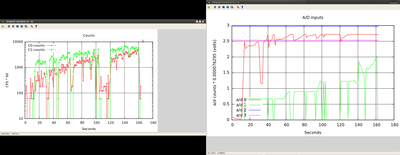
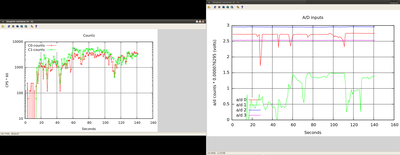
Decode for the plots. Left plot is radiation counters. Red is X rays, green is neutrons, units counts/minute (but calculated from 1 second of data per point). The background of those is higher than normal as the HV is on and the odd cosmic ray or whatever makes a little dischage even when it won't sustain. 980 cpm on the neutron counter correponds to 1 million neutrons/second. On the right plot, red is the HV voltage, green the current (10 ma limit can be seen in the first two bursts, limit set to 19 ma for the last - and you can see where the HV dropped while I set the new limit). The other lines on the right plot are a reference voltage we use to calibrate the rest of the data, and the gas pressure, which I wasn't changing deliberately, though it probably changed a little - that signal is logged before I get it, so it takes a big change in pressure to see it on the plot, as this data aq software is designed to just show me raw data, not massaged into units, so I can make sure I'm not clipping an a/d channel or whatever.
I did the initial two bursts by adjusting the ion source very near the threshold of "running", with 49.x kv and a 10ma current limit. I raised the current limit for the last one, as you can see on the plot, and it scaled, which is not the usual response; normally it's less than linear as increased current messes up focus due to space-charge effects. When oscillating like this, evidently that rule doesn't apply, interesting.
Sadly, I'm currently without a working oscilloscope down there (my other one is practically built into the wall upstairs, a real pain to move) - the good one ate a lightning bolt and I've not yet replaced it ($2k! - 2.5ghz 4ch DSO). What I'm wanting to achieve here is an oscillation rate more like what would be consonant with the ion travel times. That will be in the low RF range, you wouldn't be able to hear that. But this does point up the wisdom of having "unusual ways to notice things" (or, ways to notice unusual things), in this case, my audio from a couple of extra neutron detectors makes the oscillations obvious (each click might be a burst of neutrons, and it's obviously not-random, which you cannot see in the plots at one second per point at all).
March20 2014 run with series L in main grid
Forum rules
Put data and fusor information from actual runs here. We'd like to know how well you are doing, and how you did it in some detail here. We can discuss elsewhere, this is for real reports from actual experiments only, or at least, mainly.
- Doug Coulter
- Posts: 3515
- Joined: Wed Jul 14, 2010 7:05 pm
- Location: Floyd county, VA, USA
- Contact:
March20 2014 run with series L in main grid
Posting as just me, not as the forum owner. Everything I say is "in my opinion" and YMMV -- which should go for everyone without saying.
- Doug Coulter
- Posts: 3515
- Joined: Wed Jul 14, 2010 7:05 pm
- Location: Floyd county, VA, USA
- Contact:
Re: March20 2014 run with series L in main grid
And now, with that transformer hooked up. No new video - it really looks about the same anyway.
When I tried the phase that should have "stabilized" the fusor, or in other words, when the load on the main grid increases, the ion source volts went down, it acted similar to the way it did with nothing but DC on the ion source, just easier to "tune". Still heard the medium frequency AF in the neutron counters that way. No huge change in output - I'd have to take longer runs and sweep the parameters more (in either case) to be sure, and probably add a phase shift/tuning rig to the transformer system, and/or remove or reduce the value of one or more of the ballast resistors.
Which of course, I'll be doing, but likely on another day - there are a few mechanical enhancements I need to make to make testing all this easier and safer - HV-wise. This was pretty "out there in space hay-wired" - that's no way to do this long term, just good for quickies.
But here are some preliminary plots. I DID save the log files for all of this, and will run them through the 4d plot for Q real soon (the software is not on the computer I have up right now). Looks as though we are solidly into the 6m neuts/second club if we want to be - and with virtually the same other gear we used to struggle to break a million or two with. So, call this little outing a 3x day. We'd seen more, but only for one data point, earlier - couldn't reproduce it then, but now it's just flip a switch and turn a knob. Progress!
Here's a little data for the transformer hooked "in phase" so both grids move together, though with the sizes and turns ratio involved, it's the main grid driving the ion grid. I fooled with the current limit, as you can see on the plot on the right. Eyeballing this, I'm going to predict that the high Q still happens at lower power. But my software is better than my eyeball, so we'll see shortly. Now here it is with the transformer phase reversed. I did NOT note any audible osciilations for this. Not all that different otherwise, though the other connection seemed a little better. I think the next step is reducing the ballasts - so we have more electrical Q, and doing some sort of sweep over a wide range of possible resonant frequencies here, so I can get a clue about whether we're even in the right octave here. And whether we want transit times to determine this, or we want to "force" it in some way to be just so. But this is a nice new turf to be working on, and the fusor itself just gets better and more reliable every time it seems - it's been a long slog to get to where there are no squirrely HV feedthrough/heat/grid issues, but those are all gone now, it seems, and we can now take everything the power supply can dish out - about 2.5 times what's shown here, in current.
Bodes well for bringing the monster 100kv supply online soon, as well.
When I tried the phase that should have "stabilized" the fusor, or in other words, when the load on the main grid increases, the ion source volts went down, it acted similar to the way it did with nothing but DC on the ion source, just easier to "tune". Still heard the medium frequency AF in the neutron counters that way. No huge change in output - I'd have to take longer runs and sweep the parameters more (in either case) to be sure, and probably add a phase shift/tuning rig to the transformer system, and/or remove or reduce the value of one or more of the ballast resistors.
Which of course, I'll be doing, but likely on another day - there are a few mechanical enhancements I need to make to make testing all this easier and safer - HV-wise. This was pretty "out there in space hay-wired" - that's no way to do this long term, just good for quickies.
But here are some preliminary plots. I DID save the log files for all of this, and will run them through the 4d plot for Q real soon (the software is not on the computer I have up right now). Looks as though we are solidly into the 6m neuts/second club if we want to be - and with virtually the same other gear we used to struggle to break a million or two with. So, call this little outing a 3x day. We'd seen more, but only for one data point, earlier - couldn't reproduce it then, but now it's just flip a switch and turn a knob. Progress!
Here's a little data for the transformer hooked "in phase" so both grids move together, though with the sizes and turns ratio involved, it's the main grid driving the ion grid. I fooled with the current limit, as you can see on the plot on the right. Eyeballing this, I'm going to predict that the high Q still happens at lower power. But my software is better than my eyeball, so we'll see shortly. Now here it is with the transformer phase reversed. I did NOT note any audible osciilations for this. Not all that different otherwise, though the other connection seemed a little better. I think the next step is reducing the ballasts - so we have more electrical Q, and doing some sort of sweep over a wide range of possible resonant frequencies here, so I can get a clue about whether we're even in the right octave here. And whether we want transit times to determine this, or we want to "force" it in some way to be just so. But this is a nice new turf to be working on, and the fusor itself just gets better and more reliable every time it seems - it's been a long slog to get to where there are no squirrely HV feedthrough/heat/grid issues, but those are all gone now, it seems, and we can now take everything the power supply can dish out - about 2.5 times what's shown here, in current.
Bodes well for bringing the monster 100kv supply online soon, as well.
Posting as just me, not as the forum owner. Everything I say is "in my opinion" and YMMV -- which should go for everyone without saying.
- Doug Coulter
- Posts: 3515
- Joined: Wed Jul 14, 2010 7:05 pm
- Location: Floyd county, VA, USA
- Contact:
Re: March20 2014 run with series L in main grid
Whoo Hoo! Moved the log plots to the big machine, where I have Q-plots. An increase in Q of 600 was in the worst config, 1800 in the best one, transformer out of phase. More to come, still cleaning up the champagne for now. I need to take a *lot* more data on this. A scatter plot with only a couple hundred points is a bit sparse to make fine observations about, but yes, this looks like we're on a new and far better path at this point.
Posting as just me, not as the forum owner. Everything I say is "in my opinion" and YMMV -- which should go for everyone without saying.
- Doug Coulter
- Posts: 3515
- Joined: Wed Jul 14, 2010 7:05 pm
- Location: Floyd county, VA, USA
- Contact:
Re: March20 2014 run with series L in main grid
Here's the 4d plots of 3 short runs combined. At this point, there is evidently too much ballast series resistance for the feedback transformer to do a lot, but I didn't have a working scope to verity that, just my ears and the neutron counters at the moment. Color is, as usual, the pressure, and my gage reads about 2x high (according to Pfeiffer, for H2). 980 cpm on the neutron detector we acquire with is 1 million neutrons/second.
Posting as just me, not as the forum owner. Everything I say is "in my opinion" and YMMV -- which should go for everyone without saying.