A little further progress. Unlike the brandy new Pfeiffer for which I basically paid retail, this one is easy to communicate with as these things go. No ignorant windows CE board on the mass spec which does nothing but create a DCOM object the PC can manipulate (if you turn off all security settings on your network, doh, sounds like a great idea), with the PC still actually doing all the work because someone couldn't design a good system.
Nope, this is just a good 'ol z80 class cpu, serial communication, slow, reliable, simple. I'm just now writing the subroutines for the eventual nice gui program for it -- and am getting the real numbers so I can shove them into a database, something the Pfeiffer fancy home-brew badly documented scripting language doesn't seem to allow for, just saving files manuall,,,doh.
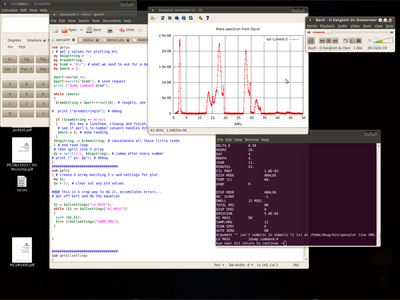
The main issues are that they were a little optimistic with that 9600 baud rate -- it's easy to over-swamp the thing and their xon-xoff proto, or DSR aren't even keeping that at bay, so I have to slow down the comm to its speed. Also, changing settings makes it restart a scan, and zero out the current one, so you have to figure out how to spin up in the PC and wait before asking for the data or you get garbage. Doing that without actually being in a spin loop in the PC and wasting cycles, while leaving the rest of the UI not locked up is a bit of a trick, but one I'm used to accomplishing.
So, soon we have the real deal, and mass spectra in the database along with the rest. Cool!
He shoots, he scores! Mass spec under $300
Forum rules
This is a good place to put pix of your lab or shop intended to produce the drool reaction. If topics get lengthy here, we may want to move most of the discussion to where it fits in the org scheme here (such as it is). Good place for announcements of things you just got working and so on. Respecting readers who may not have large bandwidth, try and keep the pictures to about one megapixel -- we have the BW and the storage here, no problems, but some readers may not.
- Doug Coulter
- Posts: 3515
- Joined: Wed Jul 14, 2010 7:05 pm
- Location: Floyd county, VA, USA
- Contact:
Re: He shoots, he scores! Mass spec under $300
Posting as just me, not as the forum owner. Everything I say is "in my opinion" and YMMV -- which should go for everyone without saying.
- Doug Coulter
- Posts: 3515
- Joined: Wed Jul 14, 2010 7:05 pm
- Location: Floyd county, VA, USA
- Contact:
Re: He shoots, he scores! Mass spec under $300
Well, getting the software a little better now, still lots to do, but it's good enough now to judge the mass spectrometer itself. I think those peaks on the tails of the "real" peaks are an artifact of not having quite the right ac/dc ratio on the quadrupoles, and that I might have to get in there and tune a trimpot (if I can find the right one). That's one of the possible reasons for non symmetric peaks listed in the book Quadrupole Mass Spectrometry and its Applications edited by Peter H. Dawson -- a good book on the theory of these, though pricey and full of exotic math.
Here's what it looks like tuned up as it is, with long dwell time, a smaller mass range, and a log plot in gnuplot.
Anyone else gotten that deep into one of these?
Here's what it looks like tuned up as it is, with long dwell time, a smaller mass range, and a log plot in gnuplot.
Anyone else gotten that deep into one of these?
Posting as just me, not as the forum owner. Everything I say is "in my opinion" and YMMV -- which should go for everyone without saying.
Re: He shoots, he scores! Mass spec under $300
I do have to say Dycor does give good documentation on their units. The manual for my Dymaxion goes through all the serial commands to talk to it. I though I was going to have to do something like what you are doing till I called them up and they were kind enough to give me a copy of the control software.
I recently picked up a spare electronics package for mine. Its actually for a 200AMU unit but the board that I need is the same part number. Also the power input/communications board is rather interesting. It provides a network connection for the RGA. Its got one of these little modules to do the dirty work:
http://www.digi.com/products/wireless-w ... p#overview
I recently picked up a spare electronics package for mine. Its actually for a 200AMU unit but the board that I need is the same part number. Also the power input/communications board is rather interesting. It provides a network connection for the RGA. Its got one of these little modules to do the dirty work:
http://www.digi.com/products/wireless-w ... p#overview
- Doug Coulter
- Posts: 3515
- Joined: Wed Jul 14, 2010 7:05 pm
- Location: Floyd county, VA, USA
- Contact:
Re: He shoots, he scores! Mass spec under $300
Wow, I checked that link Jerry -- that's one nifty thing, your basic 300lb woman in a 0.02 lb box indeed. A little pricey, but if it works as claimed, heck, way worth it for a lot of things.
(anybody else into computers check it out)
The sweet thing about Ethernet compared to many other things is the galvanic isolation, super nice to have around big HV power supplies -- it's amazing how much voltage you can induce in a ground wire with an arc. The computer by the fusor is actually not wired out -- it's a wireless connection to my network as when you get that close in, the 500v isolation from ethernet isn't enough.
I'm not minding the software effort on this -- it's all organized into nice little pieces I'll be able to use over and over on later projects anyway. I'm just using gnuplot to make the nice pix, easy, and seems too fast to be true, but hey, I'll not complain. What I have to do now is tweak the DC/AC ratio on the quads to make it artifact free, then it will be a lot more useful. Might even resolve the difference between two ways to make "6" amu for example -- it will go to 15 samples per amu.
(anybody else into computers check it out)
The sweet thing about Ethernet compared to many other things is the galvanic isolation, super nice to have around big HV power supplies -- it's amazing how much voltage you can induce in a ground wire with an arc. The computer by the fusor is actually not wired out -- it's a wireless connection to my network as when you get that close in, the 500v isolation from ethernet isn't enough.
I'm not minding the software effort on this -- it's all organized into nice little pieces I'll be able to use over and over on later projects anyway. I'm just using gnuplot to make the nice pix, easy, and seems too fast to be true, but hey, I'll not complain. What I have to do now is tweak the DC/AC ratio on the quads to make it artifact free, then it will be a lot more useful. Might even resolve the difference between two ways to make "6" amu for example -- it will go to 15 samples per amu.
Posting as just me, not as the forum owner. Everything I say is "in my opinion" and YMMV -- which should go for everyone without saying.